





Conducted in partnership with the Austrian State Printing Company (OSD)
Discover how youniqx’s iterative usability testing blends pragmatism with critical reflection to build better digital products, faster. A real-world approach with real results.
Why We Approach Usability Testing Differently
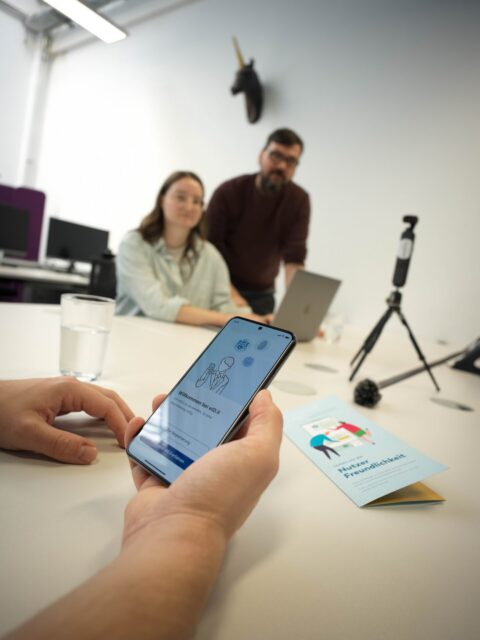
Digital products live or die by their usability. Even the most sophisticated feature or beautiful design loses its value if users can’t navigate it. That’s why at youniqx Identity AG, a subsidiary of the Austrian State Printing Company, we developed an iterative testing method based on the proven principles of Steve Krug, Jakob Nielsen, and Lean UX – while also acknowledging their limitations. Every two weeks, we run usability tests using high-fidelity prototypes built in Adobe XD and Figma. Testing participants receive realistic scenarios consisting of 3 to 4 tasks, which they complete independently and without any interference from UX experts. They decide when a task is considered done. This allows us to observe authentic user behaviour – exactly in line with Krug’s philosophy.
Our Testing Process: Iterative, Realistic, Interdisciplinary
- Start small, test often
Following Nielsen’s research, testing with 3 to 5 users per target group is enough to uncover 80 – 85% of the major usability issues. Frequent, small rounds provide more value than large, infrequent test sessions. - Realistic tasks instead of artificial clicks
Users work through real core tasks: from submitting an application to finding information. Using the “think-aloud” method, we can instantly detect misunderstandings and usability barriers. - Team-driven analysis
The entire product team – designers, developers, product managers, and stakeholders – participates in reviewing the insights. Findings are prioritised immediately and fed into the next sprint. - A continuous Build-Measure-Learn cycle
After each round, we improve the prototype and test again. Continuous learning replaces one-off usability events.
The Benefits: User Proximity, Efficiency, and Clear Insights
- Greater team empathy: Everyone witnesses real user feedback firsthand, fostering motivation and shared ownership.
- Rapid iterations: Instead of waiting for “perfect” test conditions, we refine the product continuously.
- Clarity and focus: The results highlight genuine usability barriers – not internal opinions or minor cosmetic issues.
But We Take the Criticism Seriously
While the principles of Krug, Nielsen, and Lean UX are powerful, they’re not without limitations. Common criticisms in the UX community and how we address them:
- “Five test users aren’t enough.”
For complex or diverse products, we expand sample sizes or run separate tests per target group. - “Lean UX leads to rushed decisions.”
We document all insights systematically in a central tool to ensure transparency and long-term traceability. - “Guerilla tests aren’t representative.”
To avoid skewed results, we recruit users systematically based on well-defined target groups and leverage the reach of our parent company OSD. - “Continuous testing is difficult to organize.”
We’ve established clear processes, roles, and routines – ensuring that iterative testing remains structured and efficient.
Conclusion: Hybrid Is Better
Our approach shows that iterative usability testing based on Lean UX, Krug, and Nielsen works—when applied flexibly and thoughtfully.
We blend pragmatism, efficiency, and user-centeredness with critical reflection. This gives us the ideal balance between agility and depth: quick insights through small test cycles, enhanced by more comprehensive research whenever products or audiences demand it.
In short: At youniqx, usability testing isn’t a rigid method but a continuous process – one that improves our products step by step, together with the people who use them every day.